Sunday, November 12, 2000

O e-marketing e a II Semana Nacional de Marketing

1.O tema da II Semana Nacional de Marketing e o . Qual é o ponto de situação do mercado nacional nesta matéria? As empresas já estão sensibilizadas em relação às novas tecnologias? Em que sentido? O que falta ainda fazer?

Julgo não se poder afirmar que a maioria das empresas portuguesas – nomeadamente as PME ‘s - se encontrarão totalmente sensibilizadas para a utilização das novas tecnologias, como o aproveitamento dos chamados meios remotos, como a Internet. No entanto, como já tive oportunidade de referir, penso que os marketeers portugueses se encontram tão informados como os seus pares de qualquer outro país europeu, para poderem vir a desempenhar o motor de transformação necessário à modernização das empresas.

Em consequência, o processo que poderá acelerar esta evolução e modernização, passa pela contratação de gestores e marketeers especializados; pelo papel a desempenhar pelas autoridades económicas, nomeadamente a nível das infraestruturas de ensino, pelas associações patronais, pelas empresas de consultoria e pelas novas empresas incubadoras de negócios.

Acrescentaria, no entanto, que embora as novas tecnologias tenham vindo a conduzir ao alargamento da panóplia de canais de distribuição, elas próprias vieram possibilitar não só isso mas, principalmente, a viabilidade e diria mesmo a imprescindibilidade para as empresas, de encarar formas totalmente novas de fazer negócio, mesmo no domínio dos produtos e serviços já existentes. Quero dizer com isto, que o consumidor tem hoje à sua disposição meios que lhe permitem obter um máximo de informação, de proceder às suas escolhas de uma forma interactiva e actuante, donde as empresas vencedoras no futuro serão as que tiverem a capacidade para responder a esta cada vez maior exigência e conseguirem antecipar e propôr as soluções mais individualmente adequadas a cada um. Trata-se, na realidade, da capacidade prática em estabelecer uma relação pessoal com o cliente no limite, totalmente integradora, das experiências anteriores bi-laterais, qualquer que tenha sido o local, meio ou canal de contacto.


2. De que modo as novas tecnologias podem auxiliar a técnica de marketing?

As novas soluções tecnológicas – de software e hardware de informação e de comunicações – vão precisamente possibilitar a sistematização e a organização do registo de factos e dos momentos de contacto – dos já designados por momentos de verdade - em informação, a qual permitirá responder às questões que acabei de referir. Estamos claramente no domínio, usando alguma já metalinguagem dos marketeers, do Entreprise Resource Planning (ERP), do Customer Relationship Management (CRM) e da integração de soluções e plataformas Intranet/Work flows e Internet/Extranet, na própria organização das empresas.

Os desenvolvimentos das tecnologias de comunicação (www, serviços wap, televisão interactiva, telemóveis de 3ª geração) estão/irão permitir dar impulsos significativos ao que se poderia designar pelo “Martini Marketing” (em qualquer lugar, a qualquer hora, e de qualquer forma), atendendo à cada vez maior mobilidade do consumidor e desejo inerente de comprar ou utilizar serviços quando e onde entende que o quer fazer.


3. Qual foi o montante investido para a realização deste seminario?

O V Congresso Português de Marketing (V CPM) constitui o ponto central da II Semana Nacional de Marketing. Estamos a falar de um conjunto vasto de eventos, que vão desde o que designamos por Iniciativas Regionais, que estão a decorrer de norte a sul em todo o país, em 13 e 14 desta semana; o V CPM, a decorrer na FIL, Parque das Nações, em 15 e 16; o Encontro Nacional de Estudantes a realizar no mesmo local, na sexta-feira 16 e, a finalizar, a Festa do Marketing a ter lugar na noite também do último dia da Semana.

Constituindo as iniciativas regionais um encargo directo das diversas universidades e institutos superiores, a APPM presta no entanto um apoio traduzido, pela integração coerente na temática da Semana, por alguma cobertura mediática e pela presença pessoal- nos casos em que nos é possível – de alguns dos nossos membros da direcção. Estamos, contudo, a falar de um programa vasto e ambicioso, pelo que o respectivo orçamento ultrapassa os 30 mil contos, valor muito significativo se atendermos que a APPM é, naturalmente, uma organização sem fins lucrativos e cujas fontes de receita são as quotizações dos nossos associados e as contribuições dos nossos sponsors anuais e empresas apoiantes.


4.Quais são as suas expectativas em relação ao evento? Porquê?

Temos grandes expectativas em relação aos eventos desta II Semana, subordinados ao tema
“e-marketing”..
No que se refere ao Congresso, ele está dividido em oito secções e duas mesas redondas. Pretendendo-se dar uma perspectiva integral desta problemática, cada uma das secções corresponde a um sub-tema, desde o enquadramento até à especialidade e ao pormenor: e-millenium, e-strategy, e-consumer, e-business, e-access/e-distribution, e-finance, e-communication/e-advertising, e-instruments. As mesas redondas debruçar-se-ão sobre os Novos Negócios e as Novas Formas de Fazer Negócio na Nova Economia e sobre os Actuais e os Novos Media.

Conseguimos congregar um naipe de empresas e oradores nacionais e estrangeiros de elevadíssima qualidade. Gostaria de referir, a nível dos oradores estrangeiros, os representantes da Amazon.com, da Nokia Internacional e da Oracle, empresas líderes da chamada Nova Economia; Louis Delcart, Presidente da European Marketing Confederation, orgão europeu federador dos profissionais de marketing, de que a APPM é membro representante dos marketeers portugueses; Stan Hunter, Reitor do Oxford Business College; Marian Salzman, worldwide director da Intelligence Factory, conhecida business futurist e por alguns apelidada de nova guru do marketing.

A nível nacional, contamos com a presença de diversos especialistas que ocupam lugares de topo no meio empresarial e académico, o Prof.Adriano Freire (UCP), Eng.Jorge Coimbra (IDC), Dr.António Bernardo (Roland Berger), Dra. Ana Beirão (One-to-One), Eng.Rogério Canhoto (PT Prime), Dr.Luis Reis (Sonae.com), Dr.José Graça Bau (TV Cabo), Eng.Sérvulo Rodrigues (BES.com), Dr.Carlos Vasconcellos Cruz (Trade.com), Dr.Carlos Duarte (Oni), Dr.José Poças Esteves (PWC), Dr.Luis Timóteo (Cap Gemini E & Y), Dr.Amadeu Paiva (Unicre), Dr.Paulo Vila Luz (BPI net), Dra. Vera Nobre da Costa (Y&R), Dr.Mário Rui Santos (24/7 Media), Dr.Paulo Santos (Bates), Dr. Carlos Lacerda (Microsoft), Dr.Pedro Morais Leitão (Media Capital), Dr.Luciano Patrão (Lusomundo), Dr.Camilo Lourenço, Dr.Miguel Dias de Carvalho (Giganetstore).

Perante o conjunto qualificado dos oradores, e a excelente adesão de congressistas a este nosso evento, temos um elevado nível de expectativa quanto ao interesse e qualidade destes eventos.

Gostaria, em consequência, e refiro isto enquanto profissional pela riqueza de troca de experiências e conhecimentos que espero vir a adquirir neste evento, de recomendar vivamente que, caso o nosso leitor seja um profissional de marketing ou de gestão, empresário ou académico envolvido na problemática do marketing, não deixe de estar presente no nosso Congresso. Não serão muitas vezes aquelas a que poderá assistir a uma intervenção de Marian Salzman, ou à reunião, num só evento, de tantos reputados profissionais e académicos.


5. O quê e que se pode esperar do marketing em Portugal, nos próximos tempos?

O que não se poderá esperar do marketing e dos marketeers portugueses é um alheamento das rápidas evoluções a que os mercados, os negócios e os consumidores se encontram sujeitos.
A aplicação dos conceitos, princípios e práticas do marketing, por parte dos seus profissionais, constituirá o único motor possível do desenvolvimento da chamada “Nova Economia”.
Em síntese, penso que a Nova Economia é/será o resultado do redesenho das cadeias de valor, numa perspectiva multicanal, desde a empresa ao cliente, no mundo físico e virtual, através da integração das soluções mais eficientes e motivadoras de uma relação continuada com este último.

Caberá de entre outras áreas, certamente à área das tecnologias de informação e de comunicação, mas eu diria em primeiro lugar, ao marketing e aos seus profissionais estar na vanguarda destas transformações.
___________________________________________________
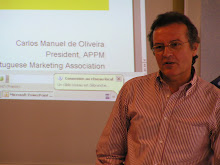
Carlos Manuel de Oliveira
Entrevista ao Jornal de Negócios, 12 Novembro 2000

Wednesday, February 09, 2000

CRM e estrategia global de negocio

marketing_mania

CRM e estratégia global de negócio

Actualmente, não será já mais possível haver um encontro em que o marketing em particular, ou a gestão em geral, estejam em foco, em que não se aborde o tema do Customer Relationship Management.
É curioso referir que embora estes conceitos só se tenham vindo a projectar recentemente, nada ou muito pouco se alterou no respeitante aos conceitos-base e à essência do marketing:
“Conhecer os clientes e as suas necessidades e disponibilizar-lhes uma oferta que os satisfaça e dê resposta aos seus interesses, atitudes e estilos de vida”.
Ou, como referem os Anglo-Saxões:
“Who’s the customer? “What’s the offer?”

- Mas, então, qual a razão do especial enfoque que esta problemática tem recentemente vindo a ter?
- Como se enquadra o CRM numa estratégia global de negócio?

Sabemos que, nas duas últimas décadas, processaram-se alterações significativas, a nível económico, social e tecnológico.
Se tomarmos o lado da oferta, no âmbito dessas alterações - potenciadas pela desregulamentação de alguns mercados e actividades - tem-se registado um elevado aumento da concorrência, pela criação de novos palcos competitivos, um ambiente promocional forte e pelo acesso a novas tecnologias de comunicações e de informação.
Do lado da procura, os consumidores estão cada vez mais informados, são cada vez mais exigentes e menos fiéis.
Em consequência, as empresas tendencialmente vêm as suas margens reduzidas, sendo que o custo de captação/angariação de um novo cliente é igualmente cada vez mais elevado, nalguns casos referido como o quintúplo da retenção de um cliente existente. Por outro lado, verifica-se que normalmente, e do lado dos proveitos, o resultado por cliente tende a elevar-se ao longo da vida de relação com o mesmo.

Não resta então, outra alternativa que não passe pela maior focalização nos clientes existentes, na relação individualizada com cada um deles, em suma pela prática de um dos outros princípios do marketing “tratar clientes – que são diferentes – de uma forma necessariamente diferente”, criando as condições para uma crescente satisfação e decorrente fidelização e lealdade à empresa.
Este processo é, contudo, atingível por etapas, desde a satisfação até à lealdade. A fidelidade e a lealdade do cliente é algo que se tem de construir ao longo do tempo e não decorre, necessária e imediatamente pelo facto do cliente poder estar eventualmente satisfeito com o produto ou com o serviço.

Como refere Jill Griffin, no seu livro "Customer loyalty: how to earn it, how to keep it" , publicado em 1995, em Nova Iorque, existem oito etapas ou estádios que o cliente poderá atravessar na relação com uma empresa: suspeito, prospecto, cliente primeiro utilizador, cliente repetente, cliente, membro, advogado, parceiro.
A arte consistirá na empresa gerir as acções tendentes a que o potencial cliente atravesse cada uma das fases, de forma a progressivamente solidificar a relação com a empresa:

- Suspeitos - aqueles que poderão teoricamente consumir o produto. De entre estes deverá a empresa determinar quais osque poderão ser considerados prospectos.
- Prospectos - aqueles que terão um interesse potencialmente elevado por aquele produto. De entre estes haverá que eliminar os que poderão não ser interessantes para a empresa, em virtude do seu risco ou potencial reduzida rentabilidade previsional.
- Primeiros utilizadores - aqueles que dentro dos anteriores prospectos, a empresa terá conseguido converter em primeiros utilizadores.
- Clientes que repetem a compra - mas que continuam a comprar das empresas concorrentes.
- Verdadeiro cliente - o que opta por comprar na empresa e deverá, em consequência, ser objecto de um tratamento especial.
- Membros - o novo desafio potenciado pela criação de um programa de fidelização que atraia e desenvolve o interesse do cliente pela fixação da relação.
- Advogados - aqueles que entusiasticamente recomendam a empresa a outros.
- Parceiros - aqueles que entendem os valores da empresa como seus e estão interessados em trabalhar em relação estreita e de parceria com a empresa, aportando-lhe as suas sugestões e ideias.
A fidelidade – a conquista dos membros - assumirá, assim, um estado superior da relação, o qual será maximizado quando o cliente atingir a fase que designaríamos por lealdade: os advogados e parceiros. Um cliente leal, será aquele que assume como seus os valores da marca e que os defende perante os seus eventuais delatores.
O alargamento das novas formas de acesso do cliente – em particular através dos canais interactivos (Internet, Televisão, Quiosques Multimedia) – em que este pode tomar opções sem um contacto directo pessoal com o prestador de serviço - obriga a uma atenção especial na forma e no conteúdo como é apresentada a oferta, em especial para os clientes com repetição de compra.
Poder-se-à dizer, que a um tradicional mercado de oferta, no qual todos os esforços são concentrados nas actividades de pré-venda e de venda, se irá cada vez mais suceder um mercado de procura, em que o consumidor sendo confrontado perante uma dada oferta, flexíval e customizável, é ele que muitas vezes sem uma influência, física e pessoal, do vendedor toma a decisão de compra.
O alargamento das formas e opções de contacto conduz igualmente à necessidade de se dispôr de um sistema de informação global e integrado, que reflicta todos os contactos havidos, através da referida multiplicidade de canais de acesso: o contacto pessoal na loja, o contacto telefónico, a resposta ao mailing enviado, a operação efectuada através da net.
Alguns operadores, como é sabido, têm vindo a disponibilizar um serviço ao cliente que reflecte, não só as transacções anteriormente efectuadas, mas o perfil detectado das respectivas preferências.
Procura-se, desta forma, criar no cliente a percepção que ele não é unicamente um anónimo dentro de um milhar de outros, mas um cliente específico que tem determinados gostos e interesses, relativamente diferenciáveis.
Dando um exemplo, já hoje "clássico", qualquer cliente da Amazon.com tem as suas preferências identificadas, assumindo claramente esta empresa o conhecimento da relação anterior e o aconselhamento de determinados tipos de produtos, atendendo àquele referido perfil detectável através da relação tida ao longo do tempo. Outros exemplos poderiam ser dados, como a Dell Computers, a American Airlines, a cadeia de hotéis Marriott.
Complementarmente, e no mesmo sentido de gerir a relação e a lealdade do cliente, várias empresas têm procedido ao lançamento de programas de fidelização e de clubes, premiando e recompensando a frequência de utilização: companhias aéreas, gasolineiras, bancos e emissores de cartões de crédito, cadeias hoteleiras.
Mas, para ganhar a lealdade do cliente, é necessário que este sinta uma forte confiança e uma forte relação de serviço da empresa com que se relaciona.
Neste sentido trata-se, de certa forma, de gerir a "relação emocional" com o cliente que, numa perspectiva figurativa, se traduz numa ponte com sentido bi-direccional, através da qual se projectam mensagens motivacionais, tendentes a desenvolver e a aprofundar os laços bilaterais dessa relação.
Com o passar do tempo, e à medida que a relação se desenvolve e intensifica, será possível criar um maior ajustamento às necessidades e atitudes dos clientes e tornar mais relevantes as mensagens entretanto trocadas.
A construção da lealdade dos clientes passa pela tentativa de retenção dos clientes certos, pela maximização do valor actual da relação numa óptica de investimento, pela antecipação e, se possível, eliminação das causas de abandono e pela conservação dos clientes actuais, através de acções dirigidas e personalizadas.
Uma eficaz gestão da relação com o cliente pressupõe uma resposta uniforme e coerente da empresa em todos os momentos da relação, pressupõe uma adequada gestão individualizada do cliente (ou, como refere Don Peppers, de um “marketing-one-to-one”).
Por outro lado, a alteração dos comportamentos-tipo dos consumidores, leva a que se tenha de atender à multiplicidade de escolhas que este efectua, por vezes em função dos diferentes ambientes em que está inserido e do respectivo contexto (ou, como refere Dubois, do novo “marketing situacional”.
Um quadro superior de empresa frequentará certamente os melhores restaurantes da cidade, vestirá no seu dia-a-dia algumas das mais caras, clássicas e conhecidas marcas, viajará em classe executiva, mas provavelmente também irá comer com os seus filhos ao McDonalds, viajará de avião com a família algumas vezes em classe económica e usará roupa desportiva nos fins-de-semana.
No domínio da gestão da relação e, em particular, nos EUA, algumas empresas financeiras começaram já a pôr em prática políticas de retenção devidamente individualizadas, atendendo ao valor económico e ao risco dos clientes, procedendo a ofertas personalizadas àqueles cujo risco de abandono é mais elevado e cuja potencialidade de relação rentável com a empresa é mais elevado.
A possibilidade de uma eficaz prática de CRM, obriga igualmente a empresa a dispôr, não só uma óptima preparação da equipa de vendas, da equipa de contacto, de instrumentos de suportes de informação adequados mas igualmente de uma própria estruturação da empresa numa óptica de pensar cliente.
Alguns erros têm, contudo, sido cometidos:
- Aproveitar as oportunidades de contacto não significa aproveitar a potencialidade dos novos instrumentos de informação sobre o cliente e, com um objectivo de cross-selling, tentar vender até ao limite, os produtos que o cliente tem da empresa, não tendo em atenção se isso corresponde, de facto, ao interesse do cliente.
- A prossecução de objectivos de vendas de curto prazo é muitas vezes incompatível com objectivos de fidelização, os quais são seguramente de médio/longo prazo.

A implementação de uma estratégia de CRM, passa pela prossecução sistemática e permanente de uma dada metodologia que se traduz em:
- Identificar e Diferenciar os clientes (necessidades, hábitos, atitudes, preferências)
- Ouvir e Interagir com eles (disponibilizar acessos alternativos com uma estrutura de preço decorrente dos custos do serviço e do respectivo valor acrescentado). Cada novo contacto deverá reflectir a acumulação bilateral de conhecimentos anteriores
- Ajustar a Oferta a cada um deles

Em termos práticos, em suma, a possibilidade de executar uma tal política obriga a:
- Um conhecimento das características de cada cliente, no domínio das necessidades e interesses e no domínio comportamental, facto que permite a disponibilização de uma oferta única e diferenciada, porque ajustada a cada um.
- Um conhecimento efectivo e disponível a cada momento, do historial da relação do cliente com a empresa, o qual através de uma análise das transacções efectuadas e do comportamento expectável, conduza à determinação de um determinado modelo de relação
- A disponibilização, à área comercial da empresa, de uma oferta flexível e susceptível de adaptação aos interesses de cada cliente
- A disponibilização de um Sistema de Informação de Marketing que permita:
- Conhecer o cliente e o valor actualizado estimável da relação ao longo do tempo (lifetime value)
- Indiciar comportamentos
- Despoletar momentos de contacto
- Transformar os contactos em oportunidades de venda
- Recolher o feed-back e assegurar uma atitude e um serviço pós-venda compatível com as expectativas do cliente.

…através de direct mail, e-mail, web sites, call centers, database software etc.

Mesmo sem ter nada estudado de marketing os nossos comerciantes ancestrais, sempre souberam da importância de reter o cliente através de uma atitude relacional, naturalmente compatível com os seus meios e conhecimentos.
A evolução dos tempos levou contudo à impossibilidade de pôr em prática – pelo menos nos grandes espaços e nos grandes aglomerados populacionais – essa forma de relação, baseada muito no conhecimento empírico e individual da parte do vendedor ou do prestador do serviço.
A existência dos grandes espaços comerciais e relacionais, físicos ou virtuais, e a aparente impossibilidade de continuar a oferecer um serviço personalizado ao cliente, criou a necessidade do desenvolvimento de soluções técnicas, designadamente no domínio dos sistemas de informação.
Neste sentido, as novas soluções de CRM permitem deter uma visão individualizada do cliente, possibilitando a adequação de um serviço, com base num sistema de informação integrado, o qual embora “industrializado”, é customizável no momento de contacto com o cliente.

Uma estratégia bem sucedida de Gestão Relacional do Cliente terá de ter como consequência que todos os interventores sejam ganhadores:
- Cliente – Ajustamento do serviço. Satisfação.
- Empresa – Fidelidade do cliente. Melhores resultados no médio/longo prazos

CRM, de alguma forma e sem qualquer acepção perjorativa, a “reinvenção da mercearia” ou a “mercearização do supermercado”.
_____________________________________________
Carlos Manuel de Oliveira
Conferência sobre CRM, Lisboa, CCB
9 Fevereiro 2000

Thursday, June 27, 1996

Direct Banking as a tool of a multi-channel distribution strategy

1. INTRODUCTION.

Banking strategists and marketeers find that, nowadays, distribution is the key element of the marketing-mix of financial services. And this is progressively true, as far as financial products, themselves, are becoming more and more product commodities.
Financial business does not deal with tangible products but with services - which are of course intangible - so a specific role has to be performed by the delivery system, I mean people and network.
In fact, the increasing degree and transparency of market information, and the impact of technology, has made possible a certain standardization of financial products, in a way that customers do not really appreciate their technical differences, but rather their availability and convenience. And this is surely pioneered by the delivery channels, and by the way customers can accede them.

2. LEGISLATIVE, COMPETITIVE AND TECHNOLOGICAL ENVIRONMENT.

Over the last two decades major changes have been happening in a business environment that was conservative by nature, fairly well regulated, and protected by financial and regulatory barriers to entry.

On the supply side, and particularly in Europe, mainly due to the integration process, deregulation and re-regulation introduced a new competition environment in the (financial) industry. I mean, EEC directives concerning cross-border financial movements, the freedom to provide services, and the supervision and regulatory changes, such as disclosure and advertising.
As far as competition is concerned, another issue that has to be considered is the awake of new competitors into the market, namely the so-called "non-banks".
These new entrants - other "non-banks" financial companies and the big retailers - began either a branchless competition, or through large retail outlets, providing services to the innumerous crowds that use their premises to do their shopping and so are able to solve several problems in a one-stop fancy way.
Another important, and clearly determinant issue, is the huge development of hardware and software solutions, and electronic communications, the so-called information highways.
In fact, apart from internal organizational impacts, technology developments turned possible the emergence of new concepts in banking:

-transactional banking, mostly performed through automatic ATM's, POS, PC Banking and Telephone outlets;
-retail business, selling products, through the new role of the branch network, and direct marketing/telemarketing procedures;
-advisory banking, through the increasable trained bank staff.
On the demand side, certain changes have clearly created new needs and behaviors in the market. These changes concern the degree of information, increased mobility, personal revenues, and consumerism.
Growing competition, educational development and the spread of new means of communication, gave pace to an increase in the level of information, (which has contributed to develop new needs in the market).
Convenience, which had along time been - and still is partially - satisfied by branch proximity and physical location, found a new more performing role through remote solutions.
The "information society" also increased the mobility of people and their demand for higher levels and time-saving, services.
The complexity of the products and the growing individuality of demand has created the need for customized and flexible services.

As some physicians say, "there are no illnesses, there are patients" so, in equal terms, each customer eventually needs different solutions, in a one-to-one marketing approach.
Quoting Mr. Hans van der Velde, President of VISA's European Union Region, "we are faced with a "New Reality" shaped by a number of factors - convergence, non-bank players, the information highway, customer demand and access".
The late developments have been possible by convergence, say "the coming together of a variety of elements, such as transformation and integration of communications, entertainment, information and computing".


3. DISTRIBUTION AND STRATEGIC IMPLICATIONS FOR FINANCIAL INSTITUTIONS.

The continuous development of technology, namely call centers' and communications' hardware and software solutions, has allowed banks to automatise certain operations which are highly transactional and so do not need real time human intervention.
This movement has helped the evolution of the banks' branches role towards customers, from money transmission and processing centers, into selling and solution providers centers.
So, banks - at least the most active ones - have been changing their role, from passive stand-by processing-focused centers, to pro-active selling ones - product-focused retail branch centers - and to added-value financial, asset and tax information management and consultancy, customer-focused centers.
In fact, banks have been externalizing low added-value transactions through automatic devices, letting branches to develop and increase their selling and consultancy capabilities.
One of the basic marketing concepts - adjustment of the offer to consumer needs - which was traditionally managed, as far as the financial industry is concerned, at the product level, and afterwards at the mix level, has been progressively tackled at the distribution level, in terms of a delivery-mix strategy, instead of a dominant channel.
Customers look for service and convenience, which can only be satisfied by integrated delivery solutions - "proposals of value" and not "proposals of products" - so, we are facing the primacy of
distribution, which is in fact the way to let services be available to consumers, and an efficient way to differentiate them.
The overall corporate strategy is therefore impacted by this reality, as it (impacts) geographical coverage decisions, product flexibility, price strategies, funding decisions and even enlarges market (capabilities).
Distribution has also been an instrument to improve customer service and to provide different solutions to different targets.
The distribution-mix approach is, nowadays, a key issue for every retail bank, as it is essential to develop the different policies of getting higher market shares, lower distribution costs, price competitiveness, and therefore higher profitability.
Distribution performs a key role in every industry, although the specificity of the financial services, have turn this issue, eventually, into the most relevant that has to be dealt with.
Marketing theory and practice teaches us that one has to find the right product, the right solution, to the customers' needs. From the corporate viewpoint, as a whole, the search for an optimum delivery mix is needed, in order to respond to those market needs in the most efficient and profitable way.

A major change that has been happening is really what we could call a "translation movement" or "change of scope", from the branch as the center of attraction of the bank - or the focus on physical evidence and the institutional place - into the customer, wherever he might be in any moment: the need of integrated service delivery networks.
Having this for granted, one of the first steps shall be the choice between integrated or stand-alone operations.

There is no special recipe through which we may apply everywhere as the best solution. In general, traditional banks might benefit from launching integrated remote channels, as they can profit from back-office synergies and, strategically will higher service level and availability, for their customer base.
This may typically be the basis of a defensive strategy towards the market, although an offensive retaining policy towards present customer base (cross-selling opportunities; expansion in the share-of-wallet and image).
Alternatively, a new or a small bank may choose a stand-alone operation - to enlarge its retail network - or even a traditional bank might do it - to target specific markets, in a more pro-active and cost-effective approach.

In broad terms, comparing a direct operation with a branch-based operation, the level of expenses will be lower for the former, in salaries, premises and processing costs, and higher in promotion, hardware and communications, the overall balance being in favor of remote banking.
These (empirical) conclusions lead to the evidence of the best choice, being the need for a multi-channel integrated distribution strategy.

4. INBOUND AND OUTBOUND TELEPHONE BANKING

Some studies have been carried out, among the banks in Europe and in the United States, showing the acceptance and usage of remote and telephone banking services. As it is known, the Americans are definitely leaders in the field. It is averagely accepted that, while less than 5% of banking transactions are done by telephone in Europe, this figure equals around one quarter in the U.S.

Apart from different cultures and habits, this shows a potential that already exists and has to be explored by the banks.
Notwithstanding the development of remote banking, the branch network - mostly in Europe - will still continue to be, at least for some years, the center of customer contacts and services. That does not mean that its role will not change, in fact it is already changing.

Talking about retail business, most of the customers will eventually search for (personal) branch advice for some more elaborated solutions, as far as asset allocation and fiscal advice is concerned.
A relatively large number of European banks already offer telephone banking services and eventually more than 3/4 of them will be offering these services by the end of the century.
Concerning market penetration - apart from the UK - a 20% average rate might be expected (UK=30%), in five years.
Actually, the response demand rate is quite low at the moment, and a range of different services is provided.

Direct banking strategies, concerning inbound and outbound operations, have been put in place, related to the different financial institutions, markets and services provided.
As far as inbound services are concerned, the role of telephone banking has been strategically faced, either as a complementary channel (integration), an alternative channel (virtual branch) and/or an alternative Bank (stand-alone operation), but always based on a customer service concept.
Customers are able to solve their problems, give their financial orders and get their loans.

So, apart from cross-selling opportunities that will eventually emerge following the initiative of the contacts with the clients, banks mostly have a passive approach, as far as inbound calls are concerned.
In fact, these solutions have been put in place, altogether or alternatively. Clearly, in the end, each bank in each country and each market, has to define its best solution, in order to reach its own priorities and objectives.
Surely, one has to take a segmented approach to the market in order to make the best choice, based on customers' demands, but also on an integrated and well-defined corporate and marketing strategy.
Outbound telemarketing is differently based on proactive strategies, targeting existing or new potential customers, in order to promote and sell financial products.

6. KEY FACTORS OF SUCCESS FOR AN EFFECTIVE INTEGRATION

There are multiple factors of success that have to be taken into consideration, in order to get the highest synergies with the branch network and an effective and integrated delivery strategy.
A clear understanding of customers' preferences is the main key point, as far as delivery choices and product offer are concerned.
Good understanding of branch managers of the overall process and impact in their branches and to the customers, is needed. Direct banking is supposed to give a positive contribution to the branch's own targets and objectives, and to increase the level of service, so the degree of satisfaction of the customers. In consequence, an effective role is supposed to be performed by the branch in promoting the service.
When the branch clear understands the value of the service, and their role to increase customers' satisfaction and reduce their administrative tasks, it will definitely help its promotion.
In the short run, the service must not be understood by the branch managers as a threat, but as a support, through a clear integration into the branch's retail strategy and marketing plan.
The ability to attract the customer base and to generate the usage of the system is also a key factor of success.
An exact definition is needed, as far as the customer is concerned, of "who decides what", and "when", so as an integrated M.I.S. and real time information .
A clear delivery strategy, must be put in place, avoiding internal competition and conflict among distribution channels and services, in order to (avoid) misunderstanding and confusion among customers and service providers (staff).

Another basic key factor of success is a (clear) segmentation strategy, as far as the distribution-mix is concerned, in order to adequate the offer to the right targets.
Although, empirical evidence shows that the early adopters of technology-based solutions are generally the younger adults (up to 35), an evaluation of the specific market conditions has to be made, in order to formulate the better and adequate strategy.
The developments of demand created new customer segments, and so segmentation has to be established considering the new consumer attitudes, behaviors, expectations and needs.
Among the younger, who are generally open-minded towards new technological solutions, some have a greater potential - as the young professionals - others might already have a wealth to protect, and others have low-earnings, and so will only use the bank for money transmission.
But older customers can also be targeted, considering that some of them have limited needs, and others are more affluent.

So, a multi and cross-matrix approach has to be adopted in order to identify behavioral types, namely the "conservatives" (branch-oriented, that eventually will never use remote banking solutions); the "integrated" (mixed-channel users, with medium or higher earnings), and the "early adopters" (technological and self-service oriented), affluent or not.
Assessment procedures and the package of services offered, have to fit the different characteristics and needs of each of those segments, I mean IVRU touch-tone services, standardized (human assistants services) or higher-level added-value consultancy services.

So, there is a wide room for the development of customized remote services, efficiently structured and priced and well-integrated in targeted mix strategies.
Facing retail business, in general terms, and for the average customer, products available through the telephone have to be simple and highly transaction-intensive.
People look for remote services for convenience and to get rapid responses for their problems. Generally speaking, customers do not look for products, but for solutions to their needs and problems. So, a wide product range of simple products is the answer to provide the solutions to those problems.
Talking about automatic services, a friendliness interface is essential to capture those who, not being so technological-oriented, belong to the "multi-channel users", and so, although more reactive than the "early-adopters" may, in the medium-run, be also targeted.

The effective promotion to existing customers, is most successfully done through direct marketing and at the branch. In-house promotion can help customers see the advantages of having alternative ways to contact the bank, mainly sponsored by their usual contacts of the branch.

7. CONFLICT OR SYNERGY WITH THE BRANCH NETWORK?

This is really an issue that has to be dealt at a corporate level, strategically in terms of medium/long term choice and, tactically in terms of the interaction with the present branch network and management.
At the strategic level, senior management has to be sensitive to customer needs and convenience and their compatibility with corporate objectives and goals, namely profitability and cost efficiency.
At the tactical level, the impact over the traditional branch network has to be evaluated and their potential (reaction) over new alternative delivery solutions, in order to diminish eventual negative reactions, not favorable to the spread out of the service.

The general argument is that a universal retail bank, in order to be efficient and competitive, has to pursue a multi-channel distribution strategy, based on a segmented target approach.
It is, in fact, a basic marketing issue, to segment the market, evaluate their needs, attitudes and behaviors and establish the most efficient and adequate mix of products and services, price, promotion and delivery solutions.
Facing customers' convenience and cost-benefit effectiveness, banks will continue to automatize low-added value operations - through ATM's, PC's and telephone-based solutions, and at the same time, letting their branches have enough time to sell products and perform customer service.

Anyhow, and in order to succeed, this cost-driven approach has to leave enough degrees of freedom to the customer. Successful banks, instead of pushing new technological solutions into the market, have to allow customers to choose and feel, each time in every moment, in every place, the most convenient "channel" to perform their operations. New developments, at the technological level, shall be understood by the customers as enhancements and ways to simplify their lives.

These are, in my perspective, the basics of a multi-channel distribution strategy: to provide a broad and efficient choice, and let consumers choose, each time in each place, the most appropriate one.

________________________________________________

Carlos Manuel de Oliveira
Seminário EFMA, European Financial Management and Marketing Association
“Telephone financial services, conflict or synergy with the distribution network”
Munique, 27 Junho 1996

Monday, September 05, 1994

A distribution and a customer service strategy in the financial services

ACHIEVING THE OPTIMUM DELIVERY MIX – A DISTRIBUTION AND A CUSTOMER SERVICE STRATEGY (*)


Good afternoon, Ladies and Gentlemen. It is a pleasure to be here. In fact, it is the first time I am coming to Argentina.
It might be pure common sense to say this. Everyone will tell this everywhere. But, you know, the Portuguese have soon liked to travel, to go far away and contact new lands.

In the 15th century we began to travel by sea, and in the 16th century we have reached Africa, Brazil, India.

"It is in our blood"-as we use to say-the will and love to travel.

I must tell you that, there might be a danger when someone comes from abroad, some thousand miles away, and begins to talk about market environment and conditions, marketing and banking management.
In fact, each country faces a different reality. Environmental, policies, behaviors, expectations, customer needs, have certainly specificities that are generally linked with different traditions and history.

Although, having been invited by the Lafferty Group, I gladly accepted.
Firstly, for me it is always exciting to face new realities, learn from different experiences.

Secondly, financial markets have been crossing, all along the last two decades, a way of liberalization and deregulation and, in the end, # do frontiers still exist with the actual level of information and technology ?

Thirdly, the "books" are always the same, whether in Europe or in South America, and so are basic theories and eventually best practices.

In the fourth place, I believe that the kind of changes I have experienced, in a way, have happened, are happening or will have to happen, sooner or later, in any financial institution.

So, I hope that even if my comments will be able to give, just a little help, to any of your banks, I will leave the country with my mission accomplished.


INTRODUCTION
The Portuguese banking system was nationalized in 1975, following a political revolution in 1974. So, in exception of three small foreign banks, all the banks in the market remained state-owned until 1986. Interest rates were administratively fixed by the Central Bank, exchange rates were controlled, and the scope of banking operations was practically designed by the government. Little room for competition was left In that environment, anyhow, banks were left with comfortable financial margins, and those who minimized risks, had a careful management and were able to maintain a sort of private management, would perform quite successfully, as my bank did.

In 1986, when Portugal became a full member of the European Economic Community, now the European Union, all the legislative and administrative environment began to change.
The basis for a new field of competition was launched in the financial industry!

The Government, ever since, has been developing a huge privatization program, and Portuguese banks began to be re-privatized in 1990.

In the last seven years, new Portuguese banks were incorporated and some of the world big names started their operation in the country.
The opening of the market has created a completely new scenario of real competition among those that were in the business for decades- but generally had heavy structures and too much white-collars- and the well-equipped newcomers, with quite well trained personnel.

So, for us, in the middle of the eighties some of the greatest challenges were:
- HOW TO TAKE ADVANTAGE OF BEING IN THE MARKET FOR 100 YEARS?
- HOW TO TAKE ADVANTAGE OF, EVENTUALLY, HAVING A CONFORTABLE MARKET SHARE?
- HOW TO BENEFIT FROM HAVING A GOOD BRANCH NETWORK?
and,
- "HOW TO INTEGRATE A SERVICE CULTURE INTO OUR ORGANIZATION?"
- "HOW TO IMPROVE CUSTOMER SERVICE? AND WIN MORE CUSTOMERS?"

All along the year of 1991, we began to feel at the bank that, although Banco Espirito Santo was one of the most important, healthy and recognized bank in the Portuguese market and even abroad, we had to react rapidly, in order to fight with the increasing competition and to keep, and eventually grow, our market share.
For years, banks waited their customers to go into their branches, or eventually sent representatives to some companies hoping, in a not very active way, that a deposit would be made or a loan could be granted.
Although, the eighties brought up new products and services and customers began to demand a new approach from their traditional banks.
Banks began to realize that the way to survive was to act in a very proactive way, finding their real customers' needs and even anticipating them, in order to launch products and services that would satisfy and give solution to the different cycles of their customers' life.
Start-ups, investment, production and treasury cycles, in enterprises. Consumption, saving, leisure and credit needs, for individuals.
In the meantime, and I mean in Europe, where in most countries law allows banks to be universal, branches became a global distribution channel and managers found good opportunities to develop cross-selling activities.
Clients were there!
Why not profit from it, and develop contacts, with real and/or potential customers who had always had a good image of their bankers?
Banks soon realized it, and even more did insurance companies! So, it looked like the secret was to find out how to take advantage of this positive position. The answer was simple enough: to strengthen relationship with customers.
And how? Through cross-selling programs and overall quality projects in order to improve customer service.
And how could we proceed with these objectives?
That is exactly what I am going to try to elaborate giving, notwithstanding, my experience, what I think could be put into action in any bank, facing the same problems and targeting the same objectives.

STEP 1: DEFINITION OF STRATEGIC OBJECTIVES
This should really be the first step of any project, namely the one I have experienced.
The general objective was to develop a new concept of an integrated customer service and quality program, differentiating the service provided by our bank.
We have also defined as specific objectives:
-To create a customer friendly branch environment;
-To develop client segmentation at the branch;
-To integrate planning, marketing (merchandising, segmentation, promotion) and sales;
-To intensify cross-selling.

STEP 2: INTERNAL DYAGNOSIS
The second step is to make an internal evaluation on how the level of the bank’s service is understood by the ones that provide the service, I mean, the employees of the branches.
It is an interesting step because one can find out and even measure the profile of competences of the personnel and evaluate internal strengths and weaknesses, problems and solutions.
This analysis, which is supposed to be participated by all the members of the branch, also helps to discover the different profiles of each employee and the possibility of recon version.
One can expect that such an analysis will lead to conclusions like:
-The need to develop polyvalence of the employees of the branch;
-The need to intensify team work;
-The need to simplify administrative circuits and to concentrate on selling actions;
-The need to develop training programs in order to increase expertise and motivation.
A survey conducted, in 1992, by an independent consultancy firm, on behalf of the European Finance and Marketing Association (EFMA) revealed that:

-Bank representatives devote less than 50% of their time to commercial contacts, that is to say, to sales; Their commercial efforts are especially directed to existing clients;
-An important part of the clientele is rarely contacted;
-In some European countries (like France, Spain, Germany, Great Britain) commission-based salaries or annual rewards are used as sale incentives.
Just for the sake of curiosity, and at the same time showing an Europe of contrasts, the EFMA
study concluded on the ideal profile of the staff of a branch designing an efficient bank's representative as the one that:
- devotes the same amount of time to commercial activities as a French does (around 60% of the time);
- manages a portfolio the way a German does;
- prospects like a British;
- makes as many contacts as a Spaniard;
- has the same access to information technology and commercial tools (segmentation) as a French;
- has the commercial animation system of a British or a French.
Another survey, also made last year in the United States by the Advisory Board Company, an independent association of banks all over the world, stated on the need to create sales opportunities, concluding that "many branches rely on the flow of natural branch traffic, managing "order-takers" rather than true salespersons".

STEP 3: EXTERNAL DYAGNOSIS
It is absolutely crucial to study how the banks' customers see their own bank, which are the clients expectations and what suggestions do they have to improve the service provided. In order to achieve this goal, quantitative and qualitative studies must be done.
In our evaluation we found out that 50% of our clients came, at least, once a week to the branch, and the remaining 50%,once or twice a month.
Considering the objectives of their visit, 85% of them came to make a simple deposit in a current account or to write a cheque.
The results of the external questionnaire told us that these clients expected the banks' service to be provided with:
- Speediness
- Sympathy
- Competence.
Important reasons to choose a bank were also, the geographical localization (proximity), word-of-mouth and competitiveness of rates.
Company managers give a great importance to the availability of products, the ability to provide taylor-made services and the expertise and know-how of the employees.
In consequence, we concluded that:
-We had to make externalization efforts, in order to turn simple operations into quick contacts with the bank.
With this objective we have developed an internal automatic area, where simple operations could be rapidly done.
-This automatic area had to be transitional, to facilitate contacts with the internal staff, should our clients require any information, and also to allow us, by means of a merchandising system, to "attrack" them into the branch;
-We expanded the deliverance of debit cards, under the principle one customer/one card, in order to promote automatic operations, inside the bank and at P.O.S.;
-We continued to develop home and office-banking services, specially for corporate customers;
-We have initiated direct sales, at first, by mailing and, afterwards, by telephone.
-We had to transform an organizational system with a traditional operational focus into a market-based organization, with a segmented distribution network, namely:
* Retail Business(individuals and SME's)
* Private Banking
* Corporate Business
-We had to make the most of our customers' visits to the branch, I mean to try to cross-sell them our products.
This simple word sell, really meant something new to a bank some years ago.
How could a typical public-service, sell products?
Surely, this was the threshold of a new era for the banking business!
And so it was... In fact, we were talking about an enormous change... in settled practices, in attitudes, in employees' behavior...
And once more, the question was simple to answer:
-To evaluate customer needs
-To look into our offer
and, to search for the products and the level of service that, would give an answer/satisfy the needs of our clients and could have a positive effect on our P.& L.

STEP 4: TO DEVELOP A CONCEPT OF CUSTOMER SERVICE
It is absolutely necessary to develop a concept of customer service based on differentiation and quality. A well-made definition can be the basis and give the guidelines to build a new organization system leading to a both-sided satisfaction process: customer satisfaction and employees' satisfaction.
The customer service concept was defined as the means used by the bank to answer our customers' needs and expectations, creating a friendly environment inside the branch, based on our corporate image and cultural values, in order to facilitate a business relationship with our customers.

STEP 5: SECTORIAL IMPLICATIONS
An integrated management of a customer service concept shall take into account the following elements:
-Objectives of the Bank
-Reception
-Logistics
-Organization system
-Information system
-Capabilities and expertise of the employees
-Leadership
So, one has to consider that it is really a global and interactive process, with consequences all over the bank.

STEP 6: PROJECT ORGANIZATION AND MANAGEMENT
Any project needs to be managed, and definitely a process of change like the one facing the introduction of a service culture, needs a special and careful management.
Most of all, it is really necessary that all the organization understands the senior management commitment to the success of such a project. We came to the conclusion that we had to engage most of the bank departments namely, marketing, commercial, human resources and EDP.
In consequence, a Steering Committee was put in place with all the departments involved in the project, coordinated by the Marketing Manager and with the presence of a member of the Board.
A Permanent Coordination Committee, also led by the Marketing Manager, assumed the necessary current decisions, such as lay out changes, training programs, EDP developments.
The third level and, eventually, one of the most important, is the management of the branch, covering the team coordination and animation, putting in action local commercial strategies and controlling performances.
It was found extremely useful to develop in-branch permanent training, rotating tasks among the staff and the promotion of every day meetings, in order to evaluate the previous day's performance and to establish actions for the new-coming day.

STEP 7: BRANCH ORGANIZATION AND LAY-OUT
It was felt that if we wanted to sale products in the branch we had to transform it into a real selling point, to satisfy and give an answer to the customers' expectations and needs.
In consequence, some measures had to be taken in order to:
-develop a flexible organization model envisaging polyvalence and multifunctionality.
-organize the staff of the branch around a model of team work.
-develop a type of organization based on a double concept, of sales team and back-office support staff.
-develop an external team of bank promoters with the objective of getting new customers and post-selling assistance to the branch's customers.
-develop a service culture, not only at the level of the branch, but also at the level of the central services.
-establish a sales planning process.
-organize the branches in accordance to the new concept, dividing each branch into three differentiated areas:
-AUTOMATIC AREA
-GENERAL SERVICE
-PRIVATE SERVICE
These well-identified areas are divided according to the types of operations and can be chosen, by the decision of a customer, or employees' suggestion depending on the type of service requested by the client.
A merchandising system is used to help the integration of products and services information; to rationalize and organizes in-branch traffic; support the development of the corporate identity, and product promotion.

The main characteristics of each area in which a branch is divided are:

- AUTOMATIC AREA
-Transitional area, at the lobby of the branch, which can be opened 24/24h.
-Equipped with Automatic Teller Machines.
-Possibility of making different kinds of operations without human intervention.

- GENERAL SERVICE AREA (Pre-selling)
(Quality, simplicity and quickness)
In this area, general, simple and quick operations are provided as, for instance, those made by traditional tellers. Staff working in this area is expected to make pre-selling efforts as to promote products and services, and to explain the characteristics of the products which are, at the moment, being promoted through the merchandising system or media campaigns.

- PRIVATE SERVICE (Consultative Selling
(Privacy, Availability of information)
First contacts of newcomer customers are made in this area. The act of opening an account is really the first step, and one of the best opportunities, to the possibility of providing a global offer of products and services, and so to develop cross-selling efforts.

Employees are trained to provide detailed information and consultancy on services and to make all the operations required by the customers, over the principle one client-one contact.
In two words, the main tasks are to keep and retain existing clients.

EXTERNAL SERVICE (Prospective selling)
(Extension of in-door organization)
Commercial external delegates are responsible for market prospection and for outdoor efforts of promoting and sale products and services.
The main tasks are to search for new clients and to assist the existing ones, namely professionals and SME's.

STEP 8: TO DEVELOP A TRAINING MODEL
The establishment of a training model is, eventually, the most important step in a process of change, and mostly in a process of introduction of a sales culture, of a really service culture.
Some particular objectives must be achieved:
-To change attitudes and staff behavior.
-To promote and build a team work.
-Introduce the concept of quality.
-Introduce the concept of sale.
-Specific training on products and services, not only on technical subjects, but on sales arguments and techniques.
It is important that the sales team knows deeply the offer of the bank. I mean offer and not only the knowledge of each product or service. In my opinion, it is crucial that the offer of the bank shall be structured around some concepts, if possible on a matrix-based system, considering the customer's financial needs, the segmentation of the market, and the typical moments of contact with the clients. To give an example, which is the offer of the bank that can be sold to a client when he comes to open a current account? Which are the products that the bank can offer to satisfy the need of saving?

-Specific training on sales support instruments.
Having these objectives in mind, a complete and detailed training program was established, covering different levels of responsibility, as bank clerks, promoters, branch and regional managers and even information sessions have been provided to central managers and to the executive board of directors.
An initial training package covered, among other subjects, sales techniques, the development of leadership behavior, the ability to work as a team.
All along four to five weeks, the branch staff worked in several teams, in order to strengthen interpersonal relationship, through simulated new environments. Apart from traditional methods of training, outdoor programs were established in order to create totally new environments, and to motivate people to the need of changing practices and attitudes.
We have also concluded on the need to maintain permanent and constant training activities, with self-training developments, even on a post-laboral basis, in order to keep the team up-dated with new products and services that were launched.
We have also found most useful to produce Marketing Manuals of each service launched by the Bank. In these manuals, beyond the technical details of each product on service, one can find the targeted segment and the main sale arguments concerning the product.

STEP 9:TO ESTABLISH A GOOD COMMERCIAL MANAGEMENT
One of the key factors of success is definitely the commercial management of the branch.
Having so in mind, we have established a careful commercial planning system, aiming to organize the overall activity of the branch.
Taking the environmental objectives and the global commercial policy of the bank, we have established quantitative targets of sales.
Each branch has, in consequence, to draw its own commercial action plan, considering the different priorities, as far as segments, products and staff are concerned.
Priorities of contacts are established, through an analysis of our customers' database. Then, product and cross-selling targets are established, in order to achieve the quantitative targets of the branch.
Branch transference ratios among the different areas of the branch are also fixed, so as to organize pre-selling and selling activities, and to create a global commitment and motivation to sale.
Each employee, or should I call salesman (?), has each week to fulfill contact targets and, inconsequence, a certain and quantified level of contacts must be successful.
When I talk about success I mean sales or, at least, some positive information on the possibility of a future contact. A track record of this commercial action will immediately be registered on the customers' database, through the EDP system.
Team coordination and animation is held by a commercial coordinator who shall really be a sales manager.
Leadership is another of the key elements of the project. Any program facing such a cultural change in an organization, needs a good deal of leadership and motivation of the branch manager.

STEP 10:TO ESTABLISH A SALES PLANNING PROCESS
To organize a sales force, it is necessary to establish a sale concept, based on the opportunity of a contact with a customer to be transformed into a transaction.

This contact can happen by customer's own will or by initiative of the bank.
In the banking industry, it is important that the act of sale will be the beginning of a relationship with a client.
So, the development of arguments on how to negotiate, argue and persuade to buy a product, should be, at last, understood by the client as a possibility to satisfy a certain need.
A retained customer is typically the one that feels his bank is selling him products and services he really needs, and not a product that he has, by any means, been pushed to buy.
In order to target the adjusted product to the exact customer, a management information system will give the support for the segmentation and definition of profiles.
A sales planning process will be needed to organize and quantify contacts with customers, and to measure the accomplishment of sales objectives.
A permanent follow-up of commercial action will allow the staff of the branch to evaluate its financial performance.

STEP 11: TO ESTABLISH A PERFORMANCE MOTIVATION SCHEME
Internal motivation can also be increased by means of a performance-based criteria which transforms each individual result, linked with the achievement of global profitability and productivity targets, into an annual premium (money, travel facilities,etc.).
Some countries have put in action commission-based salaries or bonus systems, trying to increase staff motivation.
These bonus are generally given to branch staff who are directly linked to sales.
We came to the conclusion that a bonus system also covering back office employees would help to increase the overall motivation of staff.

STEP 12: TO MEASURE THE DEGREE OF OUR CUSTOMERS' SATISFACTION
At the beginning of my exposé I have said that the main objectives of our project were to increase the degree of our customers' and our employees' satisfaction.
In order to reevaluate periodically our customer service program, we have established regular surveys to allow us to measure its degree of success.
As our bank, as a universal bank, has products and services available to all sorts of customers, we have been trying to evaluate, on a segmented basis,the perceived level of service, in order to compare it with the objectives of the project and the need to introduce any changes that can be felt as important by our customers.
If any conclusions can be taken,from mypaper I would say that, if one bank wants to integrate a service culture, improving customer service in its own organization, the main elements it will have to deal with, are:
-TO DEVELOP A TRAINING MODEL, BASED ON SALE TECHNIQUES.
-TO ESTABLISH AN EFFICIENT COMMERCIAL MANAGEMENT OF THE BRANCH.
-TO ESTABLISH A SALES PLANNING PROCESS, MEASURING CONTACTS AND FINANCIAL PERFORMANCE.
-TO ESTABLISH A PERFORMANCE MOTIVATION SCHEME.
-TO CREATE AN INTERNAL PROMOTION ENVIROMNENT, THROUGH AN INTEGRATED MERCHANDISING SYSTEM AND A FRIENDLY LAY-OUT AT THE BRANCH.


SEGMENTING DISTRIBUTION - The delivery mix


Theory and, I think, experience has been proving as necessary to segment the distribution channels.

In fact, if we consider that each homogeneous group of customers - I mean segment - has its own needs, tastes and behavior- as far as financial services are concerned- we easily come to the conclusion that a customized set of products and services, a special distribution channel, an identifiable sort of communication, are needed.

We are certainly talking about a specific marketing-mix for each specific group of customers If we want to create value in our services, we need to segment our customer base.

Banco Espirito Santo has been, since its foundation, a universal bank, with no specific channels to deliver its products to the different segments, apart from traditional branches. But,as I previously said, in the middle of the eighties, with the opening of the market and deregulation in the financial industry, the global environment began to change.

Increased competition and new needs began to justify a different market approach.

Finally, privatizations moved the way to new changes.

As a universal bank, BES has been serving all sorts of customers, from retail to high affluent, from individual and small to big-sized companies.

We understood that if we wanted to keep the bank as one of the most profitable in the market, we had to change. And so we did...

Different solutions could be taken into account. We thought, and we think, that our large customer base and all our branch experience along the years had built a real goodwill that had to be preserved. Basically, we kept our branches providing a global

service. But, to improve the level of service we had to specialize and train those who were dealing with the different sort of customers.

And so, considering corporate customers, we created a specific division with a specific channel to deal with corporate business.

Small and medium-sized companies continued to deal directly with the branch management.

As far as private customers are concerned, we launched a private banking channel, a service to high-income individuals and we specialized and improved the service through our retail branch network.

At the moment, we are launching a telephone-service network to those who, in spite of their level of income, need to accede fast services and do not exactly need to go, personally, to their branch.


This move is also a part of our externalization program. We have been making an effort to externalize out of the branch, banking operations that can be automatised, in special lobbies in each branch, by telephone or by personal computers in the customers' premises.


We are trying to keep, inside the branch, added--value services, but we are still "in the middle of the way".

Our approach is really customer-based. We understood that, nowadays, customers have lesser time or do not want to spare their time in banking queues. If they need a special, financial or fiscal, advice they do not mind to go to their branch and talk to their account manager. But if they need to make their basic banking operations, they do not want to take a long time and, eventually want to go to an ATM or use their phone or computer.

So, in a few words I tried to tell you the experience of my bank, as far as distribution channels are concerned.


We feel, at the moment, that we have to be flexible and be able to adapt to a moving competitive market, in order to find the solutions that are most adaptable to our customers' needs.


We shall constantly think and rethink the way to move forward.

____________________________________________________

Carlos Manuel de Oliveira
(*) Comunicação à Conferência “1st Financial Services Conference for Latin America”
Buenos Aires, 5 September 1994